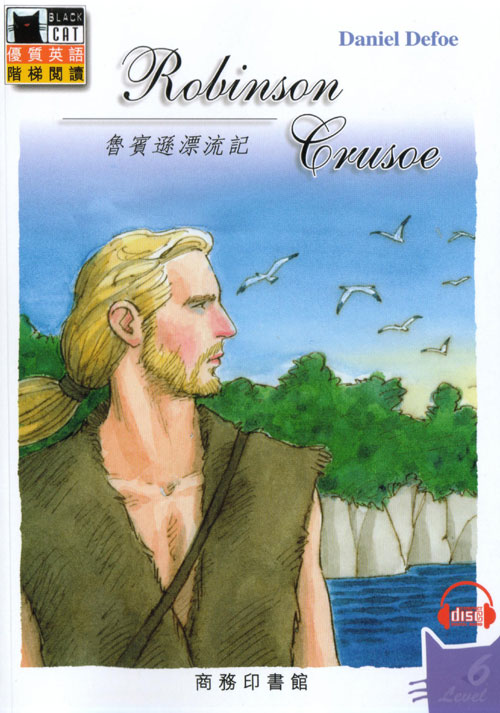
When the captain tells Robinson: “young man, you should never go to sea again… God has shown you that the sea is not for you”, Robinson foolishly ignores his advice and goes to sea again; this time with dire consequences. Forced into slavery, he escapes and is then shipwrecked on a desert island where he manages to survive through good fortune and resourcefulness.
Daniel Defoe was born in London in the autumn of 1660. No one knows his exact date of birth because his father refused to register his son’s birth. Daniel was born into a pre-industrial world, one in which there were no machines, no daily newspapers and no rapid means of transportation or communication. He was the son of James and Alice Foe. His father was a butcher and an earnest, devoted Puritan, or Dissenter, as they were called at that time.
Daniel was brought up in a family in which the predominant values were respectability, honesty, discipline, orderliness and self-sufficiency. One had to improve one’s lot through hard work. When he was still a small boy his life was touched by two horrible events which he was to remember all his life: The Plague (1665) and the Great Fire of London (1666).
During the Plague the mortality rate was so high that many people, including the Defoes, fled to the country side. Religious families like the Defoes considered the Plague a punishment sent by God for sinful behaviour. Years later Defoe’s memories of that period helped him to write A Journal of the Plague Year.
The Great Fire of London quickly followed the Plague. It burned the city for four days and nights destroying St Paul’s Cathedral, 87 parish churches, 13,000 houses and other important buildings. Young Daniel never forgot the city burning at night and the suffering of those who had lost everything.
When Daniel was 11 years old he was sent to boarding school in Dorking, Surrey for five years, where he studied Latin, Greek and English grammar.
In 1676 his father enrolled him at Reverend Charles Morton’s dissenting academy, since he wanted his son to become a minister. Although Daniel Defoe never became a minister, he received an excellent education. Reverend Morton was an erudite man and an exceptional teacher. He taught his students to write in a clear, fluent style, to read the great works of literature and to think for themselves. Daniel was deeply influenced by Morton’s teachings all his life.
Trade had always attracted Daniel and in 1680 he became a London Merchant, trading in wines and spirits, tobacco and other commodities. He worked in a pre-industrial society that was beginning to expand rapidly, particularly with overseas trade. During this period Daniel traveled extensively throughout England, Scotland and Europe.
He married Mary Tulfley in 1684 and they had eight children, two of them died in infancy. Mary proved to be a loyal and patient wife.
In 1688 the forces of William of Orange landed at Torbay in Devon and invaded England without a fight. The Catholic King James II and his regime collapsed. The changes that took place in 1688-89 became known as ‘The Glorious Revolution’, which marked the end of the divine right of kings and the establishment of the supremacy of Parliament. Daniel Defoe was an enthusiastic supporter of ‘The Glorious Revolution’ and of the monarchs William and Mary. Daniel’s business prospered for some years and he began to invest in risky ventures that led him to bankruptcy in 1692. The effect of bankruptcy on him and his family was devastating.
By 1705 he was able to pay a part of his debts, but he would never again be the London merchant he had been prior to his bankruptcy. From the end of the century he became more and more interested in journalism and literary work, and began publishing political pamphlets. His pamphlet, The Shortest Way with the Dissenters, which attacked the State Church, caused his imprisonment for six months. During the years that followed (1704-13) he published his political newspaper, The Review, which was widely read and discussed in London. He was a talented and prolific writer.
In 1719 he published his great work, Robinson Crusoe, a tale of adventure which was so successful with the newly-literate artisans and workmen that it was reprinted several times. The scholars of his epoch considered his work ‘non-serious’ because it was fiction! Within four months of its publication it was followed by The Farther Adventures of Robinson Crusoe. In 1720 he published Captain Singleton, the story about a captain who turned into a pirate. Moll Flanders, the autobiography of a prostitute, followed in 1722. His last work was Roxana (1724), the autobiography of a courtesan. Daniel Defoe, who created the English novel as we know it today, died alone in April 1731 at a lodging-house in Ropemakers Alley, London, where he had been hiding from one of his creditors.
Daniel Defoe and his World
Chapter One - Robinson’s Adventures at Sea
Chapter Two - Stranded on the Island
Chapter Three - Lord of the Island
Chapter Four - Footprints in the Sand
Chapter Five - Friday’s Story
Chapter Six - Coming Back Home